



There’s something interesting about older art that we don’t really think about. All the most famous ones seem to be depicting a very specific type of person, right? Think about the beautiful Mona Lisa, or the stunning, chiseled face of David. A quick look over of Caravaggio’s body of work will tell you that it was pretty common to make art of beautiful people. In various ways, it makes sense. The goal of art for quite a few eras, and even for some people today, is to make something pretty. Pretty people make for pretty art, that’s a no brainer. But, it’s also really boring. I don’t want every painting in a hall to contain someone trying to seduce me. There’s only so much of me to go around, after all…
Of course, we all like the beautiful women and the heroic men. But recently, I’ve learned about something that appeals to me a lot more. In my Global Baroque class, we’ve just finished talking about the Spanish Baroque. I probably say this every time we learn about a new painter, but this guy is probably my favorite. Diego Velazquez was a court artist for King Philip IV. His style is immaculate, with beautifully realistic lighting, stark drapery, and special attention to a person’s face. I don’t just mean he paints them well, I mean that he captures a bit of their soul.
There’s many different kinds of jobs in a royal court. There’s attendants, ladies-in-waiting, equerries, treasurers, and probably a million kinds of personal servants. Today, I want to focus on what we could call a court jester. A lot of people’s first thoughts of a court jester is someone funny, witty, and wearing one of those funny hats with the bells on the end. That was my first mental image, anyway. But let’s apply some historical context. Royalty lived in grand palaces, surrounded by money and hundreds of people subservient to the. They also have a bit of an inbreeding situation going on, and, well… there’s a reason we remember the Hapsburgs. Who would those types of people find funny? I don’t think wit alone would satisfy them, and it didn’t. Let’s take a look at Velazquez’s painting of Sebastian de Morra, a court jester with dwarfism.

This isn’t a very funny painting, is it? There’s a reason for that. Sebastian de Morra was in a very typical “court dwarf” role. He would tell stories and make the nobles laugh, but he was sought specifically for his height and condition. He was abnormal to them, and he was expected to take ridicule and mockery from nobles viewing him as a spectacle. You could go as far to say that his job was to lose his dignity. Velazquez returns that to him through this portrait. Note his clenched fists, or his furrowed brows. De Morra isn’t smiling, or putting on an act. His eyes seem to challenge the viewer of the painting, beckoning to see more than his role. He is a complete person, one being minimized for humor. Let’s consider the framing as well. He is seated in the bottom middle of the composition, his clothes almost touching the edges of the canvas. To me, it feels as though Velazquez created a “box” for de Morra to sit in. Still, de Morra is allowed to take up as much of the composition as required. In this painting, he is not small, nor is he someone to laugh at. He is someone to ponder.
This psychological approach to portraits was very interesting to me. I have always appreciated when art goes out of its way to connect with its viewers emotionally. It’s something I try to do with my own pieces, as well. Though, I don’t think anyone can do it quite like Velazquez. Would you come with me to look at one more piece of his?
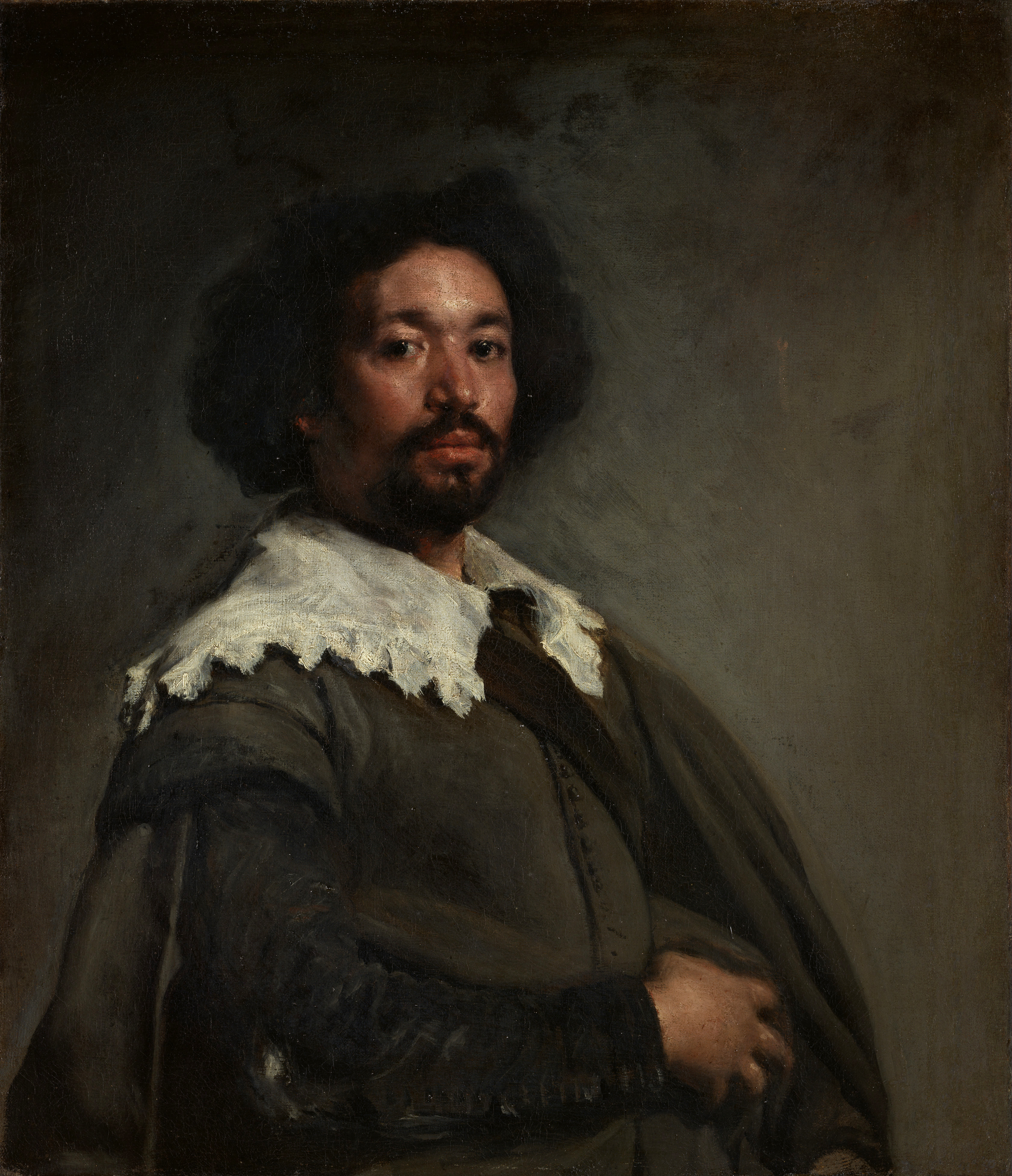
This is Juan de Pareja. Do you notice anything about him? I promise this isn’t a trap… I do actually want you to think about who he is.
Black men are not often the subjects of paintings in this era or any time before in Europe. They weren’t seen as complete individuals, or people worthy of being painted. Even jumping ahead in time, it’s hard to look at an era of art led by people of European descent and say with certainty that their depictions of other races are tasteful or dignified.
Juan de Pareja was a slave to Velazquez. Easily, Velazquez could have never painted him at all, or painted him reductively. However, he does not do that here. Juan de Pareja is painted with sophistication, and direct eye contact with the viewer—or, in the name of composition, Velazquez. Maybe you see pain in his eyes, or resentment. I see that, but I can also see pride. This is a man who endured, and who would later gain his freedom and become an artist himself. He has not lost his dignity with the years, and Velazquez chooses to include this in his depiction of the man.
Do these look like the clothes of a slave to you? I’d hope not, because this is the traditional outfit of a cavalier, a role of a gentleman and a knight. Velazquez has the viewer see de Pareja as a noble, and someone worthy of respect. We can only assume that this would contribute to the decision to free de Pareja from his oppressive position. There is a much longer story about how de Pareja came to be enslaved, but that is a longer tangent that I’d urge my readers to look into on their own should curiosity spark…
I’ll leave you all with one last question. Isn’t there also beauty in these people? They are not idealized men, but their dignity exudes a certain strength and beauty of its own kind. Undeniably, these are beautifully done portraits. They’re only made more special by who they chose to paint in such a way.
Hopefully this was a fun dive for you all today. I’d love to hear your thoughts on these paintings and the feelings you get from knowing the people beyond the paint.
Be curious,
— Ari A. 𓆟