Isn’t it neat how humans have always had a little bit of whimsy inside of them? When I’m making art, my usual suspects will be a character I think is cool, or maybe a study of a sculpture. But in the much more frequent moments where I’m not sitting down to complete a drawing from start to finish, I’m making little doodles of cats and bunnies all over the margins of my notebook. Some of my favorite drawings are the ones I didn’t think too much about, and made because I thought it’d be fun or silly.
And sure, maybe a quick pen doodle of a Godzilla sized dog laser beaming a city isn’t sophisticated art. But! Longer, professional or “real” projects can still be charming and fun.
This is one I learned about recently in my Global Baroque class. Check out David Teniers, a Flemish painter from the Baroque era! He certainly has more “serious” pieces, but those weren’t my favorites of his that we looked at. This gem of a painting that I do adore is “A Tavern Interior with Monkeys Smoking and Drinking.” Pretty straightforward title, I’d say.
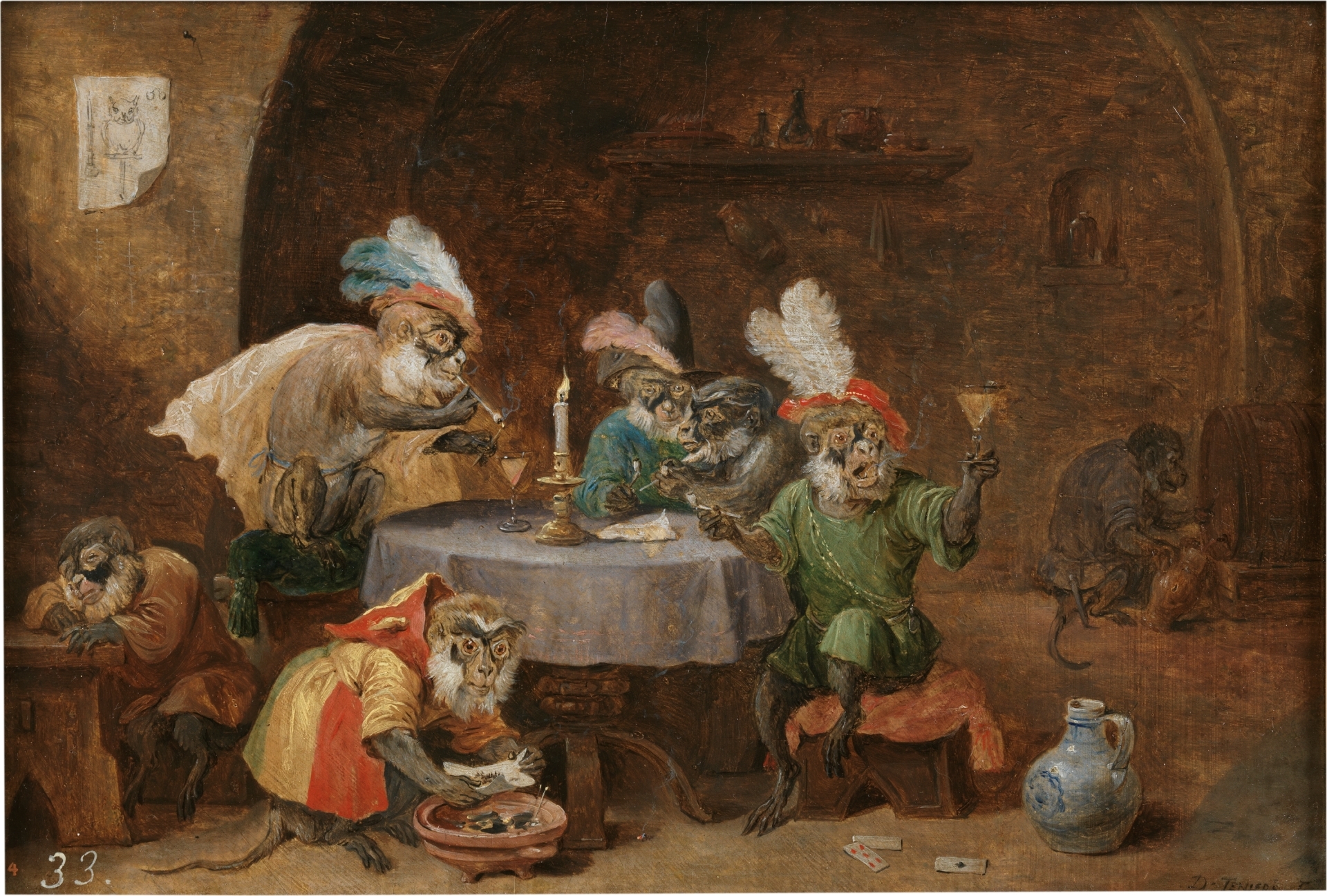
Such an odd and playful painting, amidst all the turbulence and drama you would usually associate with the Baroque… but isn’t it fun? Their hats, their clothing, and the emotion on the monkeys’ faces almost make this scene feel like a performance. When we observe this critically, some might deduce that Teniers was making commentary on the animal-like behaviors of those who frequented taverns. On the other hand, there are plenty of paintings from the Baroque that focused on tavern scenes or drinking. These “fool” characters often did a fine job at representing themselves as themselves. The consensus at the time was that the best way to portray human stupidity was to keep stupidity on human subjects. Teniers could have decided he wanted to do his own take on drunkenness, but he also could have decided that monkeys hanging out in a tavern was just funny. And giving the latter interpretation of Teniers some credit, the best way to enjoy your work is to have your work make you laugh.
And maybe if you’re a Deborah Downington, you’re going, “Smoking monkeys? Is that the best you can offer me? I need more than some smoking monkeys to believe that people back then were having fun!”
Now hold your horses, Deborah. And release your echidnas, because look at this thing from prehistory!

This is the Ambum Stone, a charming greywacke sculpture from Papua New Guinea circa 1500 BCE. Some historians think it had ritual purpose, or that it was used like a pestle for grinding.
Between you and me, it makes me happy to believe this is the prehistoric version of “I’m making this little guy for me.” Look at his elongated form. His heart shaped nose, his stylized round eyes, and his paws politely settled atop his knees. Of course, I have to put the historian lens first and say that simple, stylized forms are a key characteristic of prehistoric art. My artist lens, however, tells me that someone definitely chuckled to themselves a little while chiseling in the indentations of his paws. And how couldn’t you, when carving a cute animal that’s going to grind herbs with its butt later?
I’m not saying that every piece of art was made “just because,” nor that these pieces specifically were made for that reason either. But we have to remember that artists, even if they lived thousands of years ago, were human the same way we were. They liked to laugh. They had a sense of humor. The same way I smile after drawing a bunny with nerd glasses and two big teeth, the artist behind something hung up in the Louvre might have smiled during their process, too. We’re humans first and artists second. If we remember that in our analysis, we have a lot more fun looking at art.
The next time you’re holding a pencil, try drawing something that’s just for you. It takes the pressure off trying to make your next masterpiece if you let yourself make dumb art first. Even dumb art is important art.
The things that make me happiest are usually also the things make me go “Haha! That’s pretty stupid,” like drinking monkeys and greywacke echidnas.
Maybe you already have something like that. And if not, try to find it. It’s pretty great.
Be curious,
— Ari A. 𓆟