“Women artists. There is no such thing— or person.” —Dorothea Tanning, October 1st, 1990.
Surrealism is one of the most well known art movements of the 20th century, easily recognizable in the obscured faces of Magritte or Dali’s dripping clocks decorating college dorm rooms. Artworks identified with this movement captivate the imagination of the masses, allowing viewers to enter worlds that are dreamlike and disturbing, acting as distortions of realities we thought we knew. These pieces prompt people to reexamine, rethink, and reimagine the world in a new light. It is no wonder then, that on closer examination of Surrealism as a whole, that a disturbing attitude geared towards women is found. There is an intense obsession with women that fueled the creations of many Surrealist artworks made by men artists, the inspiration from which is largely owed to Sigmund Freud’s psychoanalysis works in the early 20th century.
To the men artists in the Surrealist movement, women were an unknown, mythological creatures from which their own untapped creativity was born. The dissected pieces of women’s bodies haunt so many canvases, giving the viewer a Petrarchan understanding of who has profoundly inspired these artists. However, in both Petrarch’s case and the Surrealists, they do not know about these women they’ve put on pedestals simply because they never bothered to talk to them. It is far easier to say something is unknowable than putting in the effort to learn and understand. For a group that prides itself into delving into the unknown, it is no small wonder that they’ve painted themselves into this corner almost willingly blind so that they might retain the mystique of their muse.
But what about the women artists of the Surrealist movement? While Surrealism was revolutionary in trying to liberate women from their passive roles in the domestic sphere and push women to artistically explore, it was largely unhelpful in allowing women to find their own creative identities since Surrealist men had pushed them in yet another passive role as muse. For those women artists that did create during the Surrealist movement, they had to do so outside of the context of the Surrealists to establish their own artistic identities. This is a reason many of those women artists during the Surrealist movement did not consider themselves Surrealists. It is also a reason why women artists such as Dorothea Tanning, also known as the last Surrealist, did not consider women artists to exist. In Tanning’s understanding, exiling women into a separate sphere was belittling since it made the unnecessary distinction of people who were simply just artists.
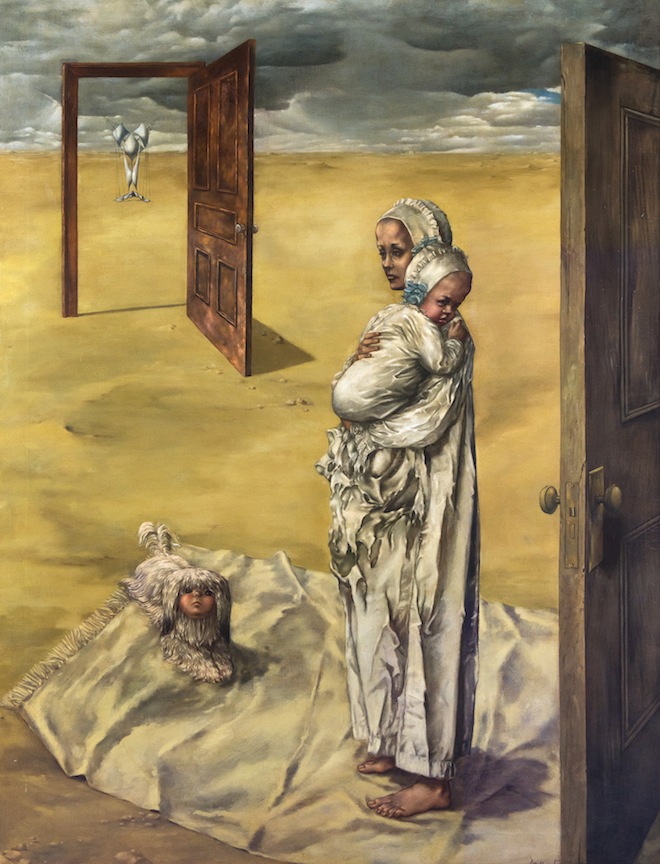
While this sentiment to erase the lines separating artists on the basis of their gender is noble and very much worth pursuing for the future, it is not an easy one to adopt against the realities of history. It is wholly necessary to investigate those patriarchal pressures that have long shaped and influenced the lives and works of so many women artists, both past and present. For Dorothea Tanning, her works are a door into the worlds of womanhood, unflinchingly presenting on canvas those realities that women face in a surreal context. In her decades-long career, some of her most famous works during the 1940s: Birthday (1942), Eine Kleine Nachtmusik (1943), and Maternity (1947), revolutionarily explore subjects previously untapped, providing a wholly unique and original perspective in a movement marked for its originality.
Biography:
Dorothea Tanning was born in Galesburg, Illinois on August 25th, 1910, to Swedish immigrant parents. Her upbringing was a conservative one and she wrote in her autobiography that during her adolescence in Galesburg “nothing happened but the wallpaper.” The local public library served as an oasis to her tedium, opening a gateway for her imagination through the works of Edgar Allen Poe and Lewis Carroll. Consequently, her thirst for creation grew and she left her conformist upbringing behind to pursue art school in Chicago, though she left it after three weeks to study independently. To support herself she became an artist’s model and illustrator, creating Macy’s department store ads in New York City. In these ads, her surrealist sensibilities can be seen before she had even heard the term surrealism. This was possible due to her love of Gothic literature, making it so she already had the visual vocabulary needed to delve into the Surrealist’s love of juxtapositions and impossibilities.
By 1941 she was signed up to the Julien Levy gallery where she exhibited her works and met Max Ernst, a pioneer of both the Dada and Surrealist movements, in 1942. The two had met through Peggy Guggenheim, an American art collector and gallerist. Ernst and Guggenheim were married during the time that she was creating an exhibition of female artists at her gallery. Guggenheim was considering having Tanning display her works and thus Ernst visited Tanning’s studio. After a week of knowing each other, Ernst left Guggenheim and moved in with Tanning, the new couple remaining married for thirty years until Ernst’s death in 1976. Despite Ernst’s fame and the almost twenty year age gap between the two, Tanning was never influenced by Ernst’s style because she had already pre-established and fully formed her own brand of Surrealism before meeting him.
Birthday (1942)
Tanning’s Birthday (1942) is the artist asserting herself as such: an artist. The piece is very static as she presents both herself and her world, inviting the viewer to get lost in it. Tanning’s verticality mirrors that of the doors, greater showing their connection than her hand on the knob. A creature, most likely a griffin, is found in the lower right corner of the picture plane just at Tanning’s feet. The creature most likely represents the artist’s creativity. It can, along with the infinite doors, also be a reference to Alice in Wonderland by Lewis Carroll, a book that was of great influence to Tanning in her youth as well as a fascination with Surrealist artists. The use of the wallpaper design decorating the walls of the room in the series of doors can relate to Tanning’s childhood in Galesburg, Illinois, a reference to her origins as an artist. In Dorothea Tanning by Jean Christophe Bailly and Robert C. Morgan, they put forth an interpretation of the work based upon its careful composition and design choices. “Consciously planned, the painting is tilted from above; its floor dips obliquely with the weight of the figures rising toward the infinity of half-open doors where the perspective vanishes at the picture’s top edge the woman…creates the mood, uneasily accented by a small hybrid creature in the foreground one of those creatures joyously trampled underfoot by the saints but figured here as the painter’s familiar spirit, heralding all those avatars of the animal demiurge that will accompany her painting in the future” (16-17). The use of the lemur also functions in a larger setting for women Surrealists. According to Whitney Chadwick’s Women Artists and the Surrealist Movement, “the lemur appears as a herald of the unconscious released through the dream; the frequency with which the image appears in the paintings of women artists suggest its adoption as a kind of talisman for woman’s visionary powers” (119).
As for how Tanning has represented herself physically, her expression is passive and distant as she looks out to the viewer. She is clothed in a doublet, something typically worn by men in the Renaissance, made from purple and yellow silk with white lace at the cuffs. It is open at the chest, leaving Tanning’s breasts exposed. Underneath the doublet and over a ragged black skirt which Tanning is holding up on her body, Tanning wears what appears to be a tailcoat made up of a green mass of writhing human bodies.
On closer inspection of the tailcoat, it is composed of both male and female bodies, primarily their torsos as well as their genitalia. In fact, a phallus is depicted urinating in the upper portion of the tailcoat, about at the artist’s pelvis. The symbolism of this can range in a number of ways. Tanning could be depicting herself wearing the subjects she paints so often in her works, the human form. It can also have to do with the Surrealist’s obsession with the human body, specifically the woman’s body, only in this case Tanning has taken both the male and female form’s and used them as props in equal measure. “Dorothea Tanning has a view of human entanglements that is indeed tumultuous, and tumult can have a potential for disaster. The first goal of her career remains to create images, disastrous or serene, that no other person can make ” (Bailly and Morgan 9). As to why the phallus is urinating, it could be for the sake of weirdness or as a power statement considering its location is at about Tanning’s pelvis in the painting. Considering later artists like Andy Warhol have literally urinated to create their artworks, like in his Oxidation or Piss Paintings series (1977-1978), it is no small wonder that men artist’s can do something so debased and be celebrated as fine artists whereas women artists have to claw at their patriarchal restraints to even be considered, at the very least, an artist.
It is unclear why Tanning has depicted herself with her chest exposed. A possible explanation is that she wishes to show herself as a real person in an otherwise unreal setting, an ownership of herself and her body. “The painting is a declaration of intent and already a sovereignty, a sovereignty heavy with a challenge, and in the challenge a foregone acceptance. The ‘sovereign’ here in this combination of disguise and nakedness has now presented herself. For the accident of birth, for the very seduction of appearance, she substitutes her declaration of a decision” (Bailly and Morgan 17). What this declaration of her decision is that she is an artist. By using her own likeness in the painting, she is rejecting the idea of the muse as Other and has instead taken on the role herself, showing that she is in charge both as muse and creator. “The idealized vision of woman as muse was no help to the young women who came to Surrealism during the 1930s seeking an artistic identity in the movement. Rejecting the idea of the Muse as Other, they turned instead to their own images and their own realities as sources for their art. Even when the subject of the work is not the self-portrait per se there is a persistent anchoring of the imagery in recognizable depictions of the artist…Their many self-portraits reveal their rejection of the idea of woman as an abstract principle, and a substitution of the image in the mirror as a focal point in their quest for greater self-awareness and knowledge. However fantastic their imagery, it remains firmly rooted in their experience of their own bodies and in their acceptance of their psychic reality” (Chadwick 81-91). For women Surrealists and Tanning, they did not see themselves as Surrealists because the group did not offer them a set of artistic goals like it did for the boy’s club Surrealists had set up for themselves. Instead, they focused on their own individual reality. In Insomnias by Charles Stuckey and Richard Howard, “One day in 1942 Max Ernst made a studio visit in connection with a show of women surrealists he was organizing for Peggy Guggenheim’s Art of This Century gallery. Tanning’s celebrated self-portrait Birthday was on the easel” (54). It is fitting that Max Ernst was the one to come up with the title of the piece, seeing it as Tanning’s first foray into the ideals of Surrealism as she herself was just turning thirty years old. “Tanning stands poised on the brink of maturity, her hand uneasily holding the knob of a door opening onto an emptiness waiting to be filled by the spectacles” (Chadwick 122).
Eine Kleine Nachtmusik (1943)
Eine Kleine Nachtmusik or A Little Night Music (1943) offers a peek into the horrors of childhood, specifically for adolescent girls. For the Surrealists who were already obsessed with women, the adolescent girl, or femme-enfant, was of particular fascination to them. “A prototype of the femme-enfant, or woman-child, that enchanting creature who through her youth, naiveté, and purity possesses the more direct and pure connection with her own unconscious that allows her to serve as a guide for man, appeared under the title L’criture Automatique…These images of the femme-enfant augur the Surrealist search for the woman-child whose presence would inevitably, and perhaps more than any other single factor, work to exclude women artists from the possibility of a profound personal identification with the theoretical side of Surrealism during the next decade” (Chadwick 35). For men Surrealists, this image of the woman-child as muse cannot be anything other than perverse and predatory, making the role they had assigned grown women as passive muses all the more off-putting when assigned to those as vulnerable as children.
Tanning refused the notion of the femme-enfant in the typical ways the men Surrealists had. Innately she had done so by being a grown woman and not a child, one who was both creator and muse and not the mere passive source of creativity for a man. In Tanning’s works she had refused to exploit the image of the femme-enfant as a plaything and instead depicted the difficulties of childhood for little girls. “These were realistically rendered and often self-referential images of zombie girls with long hair and shredded garments in bleak, sexually charged settings full of doors and crumpled sheets; they were part of an extraordinary and unsettling trend, introduced in the 1930s by such film-influenced artists as Fini, Balthus, Dalì, and Magritte in an attempt to evoke the psycho-mythic roots of human experience” (Stuckey and Howard 9).
In Eine Kleine Nachtmusik a hotel hallway is depicted in which two little girls stand and a giant sunflower sits upon the ledge of a set of stairs. “[Pierre] Roy’s Danger on the Stairs provided the theme for Eine Kleine Nachtmusik (1943) and was also an important stylistic source for Tanning’s meticulous realism” (Chadwick 180). The setting of a hotel hallway immediately provides a disquieting horror in its darkened corners and repetitive series of doors. The crack in the wall towards the upper left of the picture plane furthers the eerie, rugged quality of the space. The hotel is also sinister for its sexual overtones as they frequently act as in-between places for amorous affairs.
The fact that children are the only occupants and that they are in states of ragged undress is chilling. The girl dressed in white Victorian looking clothing is standing with her hands balled into fists as she is being confronted with the giant sunflower. Her hair billows upward, mirroring the crack in the wall above her and the ripped stem of the sunflower that looks to be puppeteering her. As for the second girl, she is dressed in a white skirt with a red jacket opened at her torso, revealing a distending stomach. She has long blonde hair which does not completely cover her head, leaving a portion of her forehead jutting forward and in general giving her a doll-like appearance. Her countenance is dreamlike and distant as she has her eyes closed, a sharp contrast to the closed fist at her side clutching one of the sunflower’s torn petals, as if she had ripped the petal herself. Continued signs of a struggle are found in the lone ripped petal draped over one of the stairs in the bottom right corner next to the artist’s signature.
Everything about Eine Kleine Nachtmusik tells the story of trauma born from the confrontation between childhood and the pressures of the adult world. The transition between girlhood and womanhood is not seamless but oft times a violent confrontation which scars the mind. The use of the sunflower as the symbol of the adult world stems from Tanning’s upbringing in Galesburg, Illinois. “Tanning removes the snake [from Pierre Roy’s Danger on the Stairs] with its Freudian symbolic content, and replaces it with a torn and writhing sunflower, an image strongly identified with Tanning’s midwestern origins, close to nature and capable of conveying impressions of both fecundity and menace” (Chadwick 180). The use of red that makes up the blonde girl’s jacket and the hallway carpet stretching towards an open door with a sulphureous glow to match the yellow of the sunflower is symbolic of blood from the menstrual cycle. The period is the inward violent marking of the end of girlhood and the start of womanhood. The distended stomach of the blonde girl is an additional symbol of this, as well as what is to await a girl’s awakening sexuality in the form of creating a child just like who she used to be. “What Dorothea Tanning seems to read in childhood and in the adolescent universe is the omnipotence of the demonic: not the famous perversity of children, but something stubborn and terrified, the constant contact of a disturbing otherness at once desired and dreaded…Everything in the haunted character of this work relates to the universe of trauma, insomnia, and somnambulism [sleepwalking]…She stretches matter to the point of invisibility, only to rediscover it ever-looming and pervasive, especially in her chosen surface image, the human body. It will be her force and her compulsion through the years to come” (Bailly and Morgan 18-26).
Maternity, 1947
In Maternity, Tanning shows a side of motherhood oft ignored. Motherhood can be oppressive, choking, and violent. The woman’s face as she holds the baby in her arms is as drained of life as the desert surrounding her, rough and weary as she gives what little she has to the being almost as big as her held in her arms. The dirty white clothes she wears are tellingly torn around her stomach, referencing the brutality inflicted on the woman’s body due from the child she has born. Unlike men, a consequence of a woman’s sexuality can be an unwanted pregnancy, an inward violence that takes a psychological toll. “The element of erotic violence so prevalent in the work of male Surrealist artists until now largely missing from the work of the women makes its first appearance in this context, in the torn and shredded nightgown worn by the female figure in Tanning’s Maternity. Here it is violence directed against the self, not the other, violence inseparable from the psychological realities of woman’s sexuality” (Chadwick 170).
Symbols of the home, such as the rumpled rug at her feet, the baby-faced dog creature, and the opened doors aid in what have led to the woman’s oppression. The pose of the mother and the creature with the body of a dog and the face of a baby who stares out at the viewer are symbols of Tanning’s own feelings of not wanting children. “Art historian Linda Nochlin has located the source for the mother’s pose in a photograph of Tanning’s own mother holding the artist as a young child, but the malevolent and suffocating air that hangs over the scene is new. Tanning herself has consistently denied autobiographical content in her painting, but friends of the artist recall both her refusal to consider having children and the devotion that she and Ernst lavished on their Tibetan dogs” (Chadwick 168).
The open doors leading nowhere show the absence of opportunities after women have children. The creature in the far distance framed by the open door in the upper left corner appears to be made out of billowing white sails, the puffs of the sails resembling breasts and a swollen stomach. The use of sails to resemble the female form resembles the emptiness a woman can feel after having children, aimless and drifting, lacking the life they used to have. The way the creature hangs there on the horizon, evading easy recognizability or categorization as it fully faces the viewer is purposefully unsettling, a symbol of the looming fate that pregnancy could lead to.
Conclusion:
When one door closes, another door opens, but one is never sure of where it will lead. For Dorothea Tanning, she uses the motif of the door to show opportunity and the lack of it, to tempt the viewer into exploring the unknown world beyond and seek understanding. This use of the door in relation to her subjects of women and the private pains they endure against the backdrop of an art movement that sought to mythologize the woman away is deeply radical. As revolutionary as the Surrealists were in their subject matter, methodology, and attitudes towards women, the men Surrealists were still limited by the past they knew and still operated under: men as active creators, women as passive muse. Much of art and its history is ingrained in this patriarchal mindset of clear distinctions, of forcing their woman subjects into Madonna or Whore; maiden, mother, or crone. For Tanning, however, she unflinchingly paints on canvas the multitudes of women’s lives that evade easy distinction, ranging from adolescence, adulthood, and motherhood (a cyclical combination of the former). While Tanning has stated that there is no such thing as a woman artist, a position that is understandable to take when one has had to fight to even be considered an artist, it is worth studying exclusively those artists not given their proper recognition based upon their gender identity. The result of doing this research for those previously closed doors of art history is examining the lock, turning the key, and entering into the unknown.