For today’s post I wanted to share a lesson plan idea with you all! This project can be done with many different age groups and will teach the students about the elements and principles of art as well as impressionism and Claude Monet!
This lesson will need materials such as crayons, green paint, pink and yellow construction paper, scissors, paper plates, and glue.
The first part of the lesson will be an introduction on Claude Monet and impressionism. This can include a PowerPoint with examples of his work and definitions of terms such as Impressionism, with a YouTube video, or with a picture book. The class will discuss the many paintings of water lilies by Monet and then introduce the project of creating water lilies with paper plates, construction paper, crayons, and glue.
The project itself will begin with drawing lines with white crayons on the paper plates and then painting them with green paint. Then the students will cut out a triangle shape from the plate to create the lily pad. Then the class will discuss types of lines (curved, zig-zag, straight) and the students will cut out the flower shapes from the yellow and pink construction paper. In the middle of the flower they will add dots for texture as well. Then they will glue the flowers to the lily pad, creating a water lily.
Once the lesson is over it can be wrapped up with an assessment method such as exit tickets or by explaining why they like each others’ work using vocabulary learned during the lesson (ex: line, color, texture).
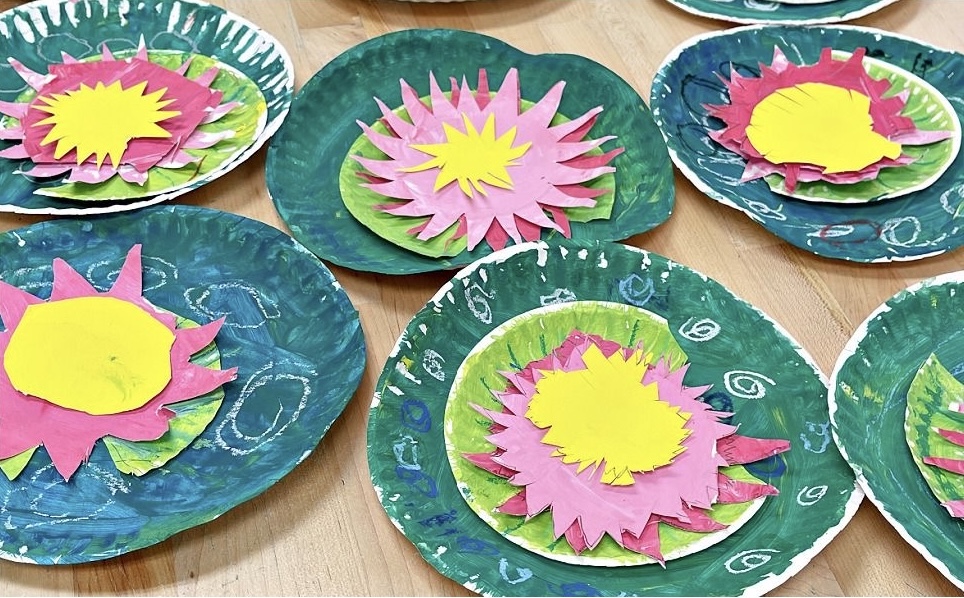
Here is a more in depth explanation of the lesson step-by-step:
- I will introduce the lesson with a PowerPoint talking about Claude Monet and his work.
- The PowerPoint will include art vocabulary that we will discuss including: line, texture, Impressionism, color, brushstroke etc.
- I will then introduce the project of creating a waterlily like Monet with construction paper and paper plates.
- First we will take white crayons to create line and texture. We will again discuss the different types of lines (spiral, wavy, etc.) and each student will choose a type of line to add to their lily pad. Then as a class we will paint a paper plate with green paint. We will also cut a triangle shape out of the side to make it look like a lily pad.
- Then while we wait for the plate to dry, we will cut out the flower shape for the lily out of colored construction paper. We will discuss each type of line (zig-zag, curved, straight) and each student will decide what type of line to use to create their flower petals.
- We will then glue together all of the parts of the waterlilies to create our finished product.
- After each demonstration, I will walk around the room as the children are working to check their understanding. I will ask each one what type of line or what colors they are using and why.
- Once we are all finished, we will take all of the finished projects and each student will have one of their peers’ projects in front of them. I will then pass out index cards to each student and give them a prompt. “I like the way you used ____ (color, line, texture) because ____” will be written on the cards. They will then answer the prompt according to their peers’ work in front of them, circling one of the answers and writing a compliment.