For as long as I’ve been an artist creating things, I’ve always just “went with the flow” so to speak. I never gave much thought as to what I made, I just had an idea and drew what was in my head. No matter if the composition “looked good” or not, or if it made sense, or if it was harmonious. I just made what I wanted to make and didn’t think twice. Which wasn’t a bad thing to do, I was having fun and learning.
But recently I met a painter, Bob Smith, at my internship at Pink Arrow Arts gallery in Montrose, PA, and we were talking about his pieces and he asked me what I did. I told him I was a surrealist self-portrait artist and he asked to see some of my work. I showed him my piece “Last Words” (pictured below) that I had made for an art exhibit. And we were talking about the piece, I don’t remember exactly what we were talking about, but one of the last things he had asked me was this: “And why did you do this specifically.”
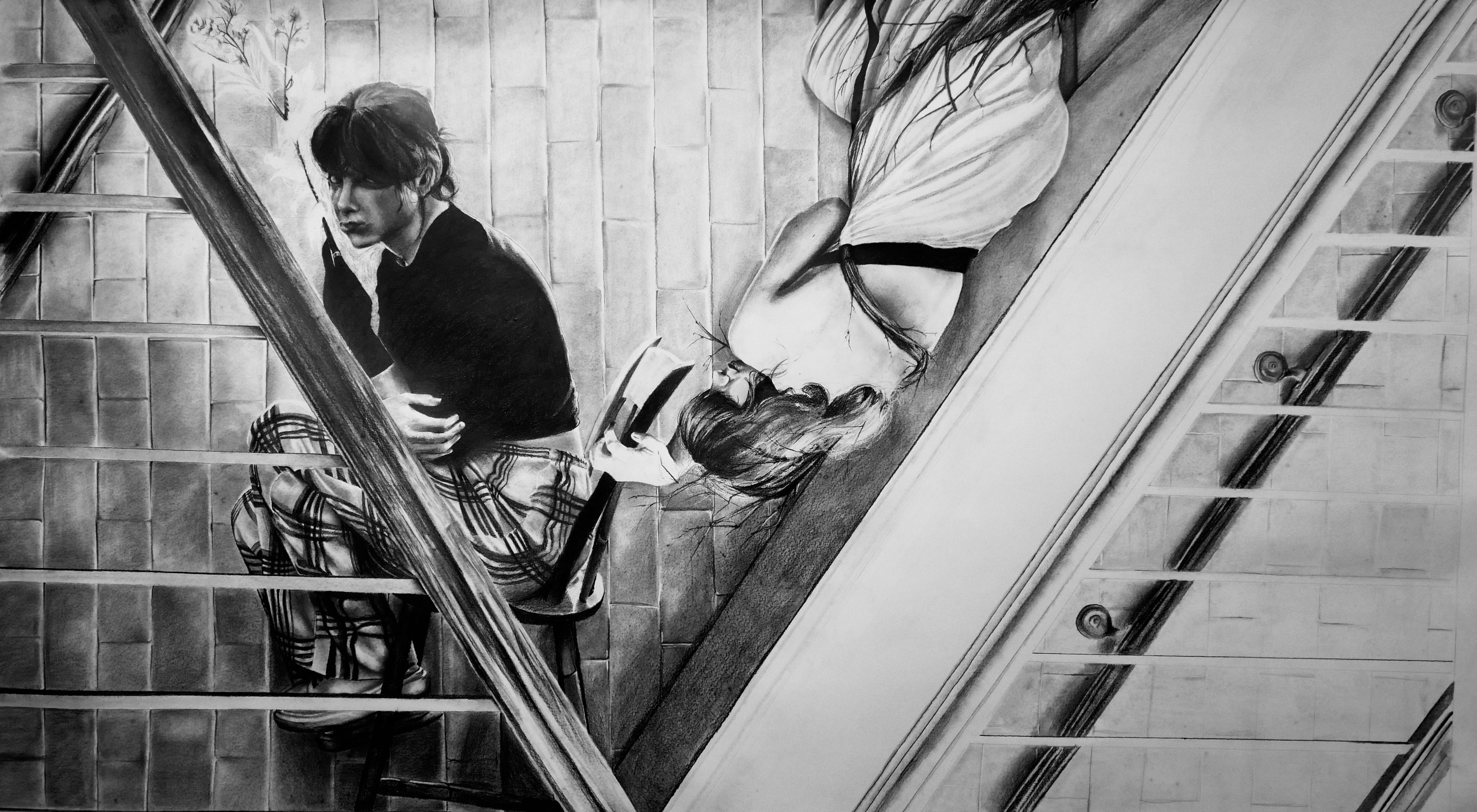
I don’t remember exactly what we were talking about, but one of the last things he had asked me was this: “And why did you do this specifically.”
Thankfully this was a piece that I had actually put some sort of thought into so I could explain why I did this and that, or why I didn’t. But him saying that had made me think about my other works. Up to that point I never really pushed myself or thought about things too hard. Sure there were some thoughts here and there, there were things I specifically wanted to add for one reason or another. But that was it. It was all just made because.
And so, recently, I’ve begun thinking more and more about the “why.” Why am I putting two figures instead of one, why am I only using the color blue or red, why did I choose this composition? That single word is plaguing the inside of my head every time I pick up my pen or pencil to draw. Which was another reason I switched to pen drawings for a bit. With pencil I can smudge things and erase, I don’t really have to think about the placement of each mark. But with pens that’s not really the case. Sure there are friction pens you can erase, and there’s always white out, but you have to think about the placement. Pen forces you to think, “okay, do I want these lines heavy or thin, do I want that much contrast in this area, how heavy should the cross-hatching be…” etc. etc.
It’s a little scary at first, going from something easily erasable to something not really at all erasable. But after a few minutes it’s fun to lose yourself in the lines and trust you know what a shoulder blade looks like enough to cross-hatch one. Keep asking yourself why you’re doing something, you don’t have to question every aspect of your drawing, nor should you, but it’ll help in the long-run to really see and know what you’re doing and what the “plan” is.
I hope everyone has a happy holiday and good new year and is enjoying the break!
~Ana Fiedler