
Anne Herrero is a contemporary artist whose series “In the Midwest” pays homage to the landscapes of Missouri while also exploring different aspects of life there from post-Roe v. Wade bans to what it means to be a woman in a majority Conservative state. Herrero’s series addresses feminist existentialism from various angles. While all of the subjects are nude women there is no intention to sexualize the nudity but instead to use the naked body to tell stories of autonomy, power, and strength. Each piece shows Anne’s close friend Lissa as the figure depicted in this essay’s three works of art. Lissa lives on a farm and glimpses of the land can be found in the settings of the paintings. Each painting depicts a story of their lives as women in Missouri, starting with States Rights (2022) which touches on the abortion bans, and a woman’s right to autonomy to Bird Watchers (2023) which gives us a glimpse into friendship and solidarity within womanhood. Lastly, Moving Target (2024) explores the idea of women as pioneers. Anne’s themes are “feminist in a raw and lonely way” (Noctis, 2023) and uniquely use the female form to make it difficult to look away or to sexualize.
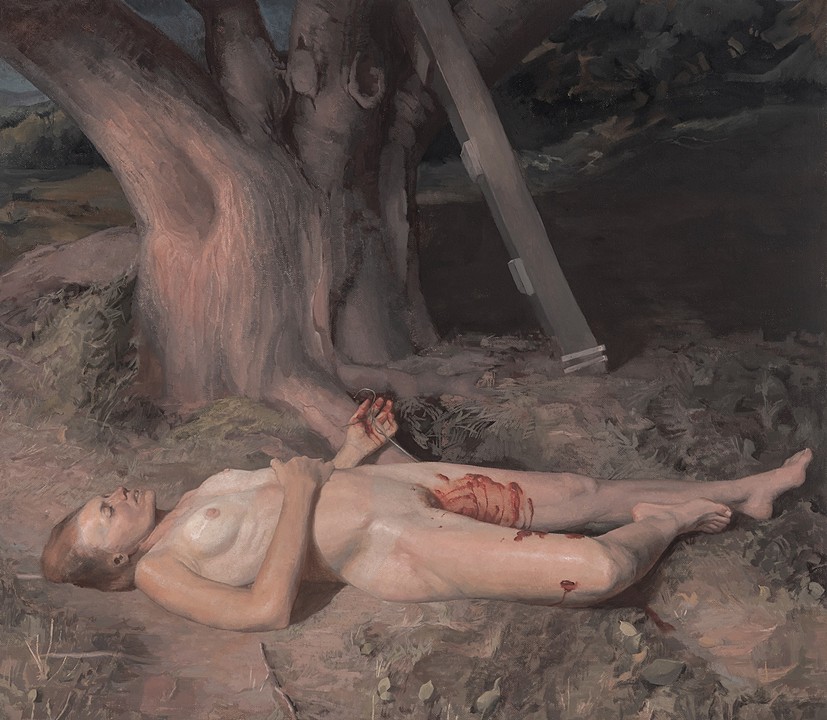
Anne considers her painting States Rights “the nexus of the series”. It depicts a nude woman lying lifeless at the base of a large tree holding a metal hanger in one hand with blood coming from between her legs. The figure rests her other hand over her stomach with a message that she has power over her body and choice. It is difficult to mistake that the subject has just performed a self-induced abortion alone in the woods. While this image could be relevant in any period, it especially relates to the current state of Missouri’s total ban on abortion. On June 24th, 2022 the U.S. Supreme Court overturned Roe v. Wade, a law that left the choice to have an abortion legally and safely up to the person who was carrying the child. The right to an abortion is no longer protected by the Constitution and more conservative-leaning states such as Missouri have started to pass trigger bans. According to an article from the Center for Productive Rights, “Now that The Supreme Court has overturned Roe, Missouri has begun to enforce its trigger ban to prohibit abortion entirely.” Herrero, like many other women who live in similar states, is deeply affected by these new laws. Women and people who can bear children have lost their rights to bodily autonomy and in many cases, the only option for anyone needing an abortion will be self-induced. This painting conveys a harsh and painful truth, the right to have control over one’s own body may mean risking death. “This is a desperate and defiant act, never made lightly. This figure is not a victim but a revolutionary.”, says Lissa in her post about the painting. Herrero uses earthy and muted tones throughout the painting, which makes the blood a clear focus that draws you in. The figure and the tree are highlighted while the rest of the background is dark. The lighting is similar to a bright spotlight on a stage which adds to the dramatic scene. The bend in the tree is reminiscent of the shape of the figure, which led me to compare both the tree and the figure having freedom over their bodies in nature outside the rules of society and the government. Anne meant for this piece to make people uncomfortable with how she painted so directly, not trying to sugarcoat the truth but to make it unmistakably recognizable. The current political climate surrounding women’s abilities to advocate for our bodies is not something we can look away from just as we cannot look away from this image. The message is imperative to the future of women, no matter how jarring.
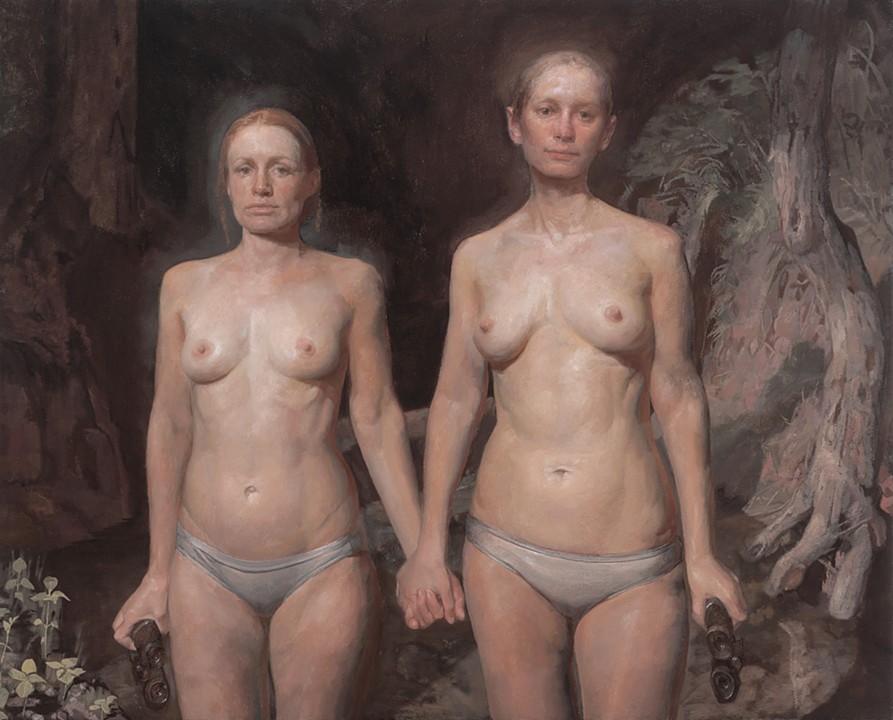
Bird Watchers depicts sisterhood and innocence, with an underlying history of friendship. Two women are standing in the forest with their hands intertwined, holding binoculars and looking directly out at the viewer. There is a sense of peace and comfort between the two figures that feels personal and intimate, a close bond. This is the only painting out of the three that is not a full nude since the figures are wearing white underwear. The white underwear is reminiscent of the innocence of girlhood and the ages before reaching puberty when girls can play outside shirtless, completely free, and unaware of what it means to be perceived and to be constantly sexualized in a male-dominated society. There is a light halo around them which also adds to the sense of innocence. The figures in this painting are a self-portrait of the artist on the right and her close friend Lissa on the left. Anne tells the story of their friendship on her website, they have known each other for a long time and originally met in the Bay Area, parted ways, time passed, and under “serendipitous circumstances” (Herrero, 2024), reconnected when they independently moved to Missouri in 2020. “As our friendship deepened so did my relationship to the land and this place I call home.” (Herrero, 2024) The theme of connection to the land carries through each of the pieces in the series as it is painted with as much detail and care as the figures themselves. This is also the only image with the figures looking directly at the viewer. The two women are holding binoculars, giving the sense they are aware of the viewer looking at them. This gives a sense of having power over their bodies and how they want to be perceived. Much of the art we study in Art History is of nude women painted by men, they were often depicted looking away from the viewer, alluding to the feeling that the women are unaware and free to be perceived. This furthers the problem with the female nude being oversexualized in art and media as an object to be looked upon for pleasure and purely for aesthetic beauty. Within feminist art, the female nude takes on another purpose and story. The objective of this movement is to “transform a woman from the passive object of representation to the speaking subject. It has articulated the right of women to represent their own bodies and sexual identities.” (Majewska, 2023) Finally, the close bond they share speaks to the idea of unity among women, and that we are far more stronger together than we can ever be apart.
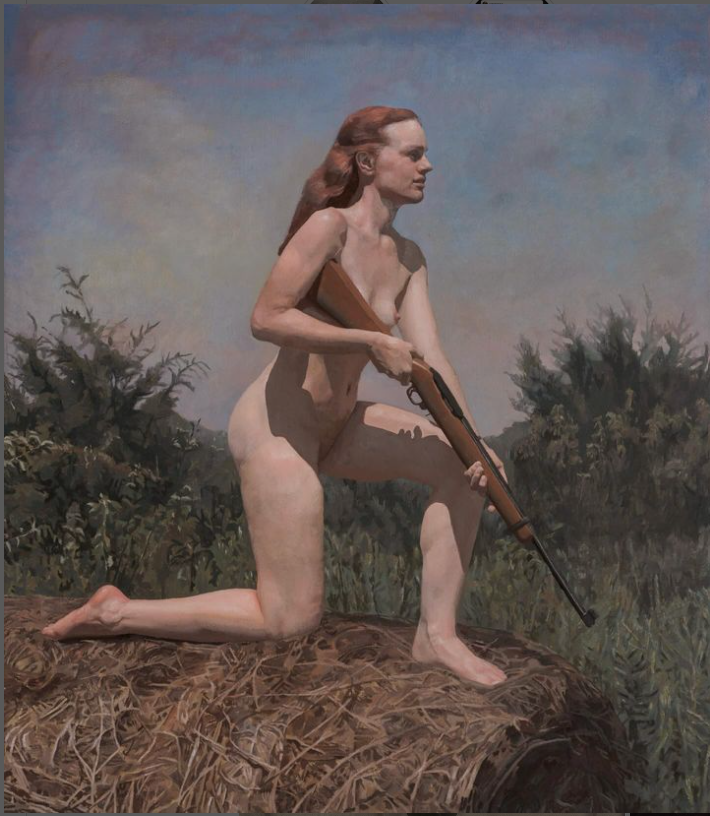
“Moving Target alludes to popular stories in American Culture such as Annie Oakley and Diana the Huntress” (Herrero. 2024) of Roman mythology. The figure, Lissa, is shooting rabbits on her property, which she does regularly, and often nude. With her pose of action and anticipation, she is locked in on her target, her senses heightened, waiting for the right moment. You can see the muscle definition in the figure and almost feel the tension in her legs and arms. In this piece, the nude body is depicted as a tool or a weapon, similar to the gun she is holding in her hands. Upon seeing this figure I thought of The Discobolus by Myron, “one of the most celebrated statues of antiquity.” It is praised as the personification of equilibrium, strength, and athletic beauty. During the Classical Greek period, male athletes were often sculpted in the nude to show powerfully defined muscles, and the body in its peak physical form. Herrero seemed to have the same intention when depicting the figure in this pose. Often female nudes are created to show sexuality and beauty and it’s less common in the art world to see a nude woman as a depiction of physical form and strength. As mentioned before, Herrero talks about how this piece was created with Annie Oakley in mind who was a famous markswoman from the Midwest, known for her sharpshooting. “She became a star in a male-dominated sport.”(McGrath, 2007) This piece speaks to the fact that women are hunters too and can be interested in sport or sustenance. Seeing a male hunter depicted in art is a common theme but the same cannot be said for women. Similar to how women have had to pave their way into the art world the same can be said for women athletes of all kinds. Despite this, proof that there have always been huntresses goes back to Greek and Roman times, with Diana. The Roman goddess of hunting, the moon, and wild beasts. Throughout history she is often depicted wearing a short tunic for agility and posed during a hunt, reaching over her shoulder to pull an arrow from her quiver or drawing back her loaded bow with the game in sight. Knowing a bit about the figure in the painting Lissa makes this piece all the more amazing. Since following her on Instagram I can see many ways that she aligns with both women mentioned, she truly embodies the aspects of both. Often she shares images of her time in the woods where she brings along her “adventure goat”, finding bones and beaver dams. She is a protector of animals if she ever sees any in need she will nurse them back to health. She is also a “good shot” (Herrero, 2024). This piece not only depicts Lissa as the figure in an overall idea that women can also be amazing woodsmen but also a portrait of how she truly embodies this image herself.


I truly feel that Herrero’s work is important and will leave a lasting impression on anyone who views it, like how it has done for me. I cannot wait to see what else she creates in this lifetime and I hope that she becomes more well known and studied since there is not much written about her as of yet. Her feminist depiction of the nude female form is refreshing and empowering and something I think is an important addition to the art world.
References
Majewska, E. (2023). Nudity as a Feminist Gesture: In Defense of a Supposedly Lost Cause. Art & Documentation / Sztuka i Dokumentacja, 29, 175–187. https://doi.org/10.32020/ArtandDoc/29/2023/18
About. Anne Herrero. (n.d.). https://anneherrero.com/page/1-About.html
Login • instagram. (n.d.). https://www.instagram.com/anneherrero/
Login • instagram. (n.d.-a). https://www.instagram.com/lissanoctis/
Missouri. Center for Reproductive Rights. (2022, September 9). https://reproductiverights.org/maps/state/missouri/