Hi everyone! This week I wanted to talk about Jan van Eyck’s Ghent Altarpiece. To begin with, Jan van Eyck was a Northern Renaissance artist. He was a popular Netherlandish artist. He is well-known today for his portraits and religious artwork. The Ghent Altarpiece, also known as the Adoration of the Mystic Lamb, was created around the 1420s and 1432. It is an altarpiece with panels that can be opened and closed.
When the altarpiece panels are closed, we are presented with the Annunciation scene.
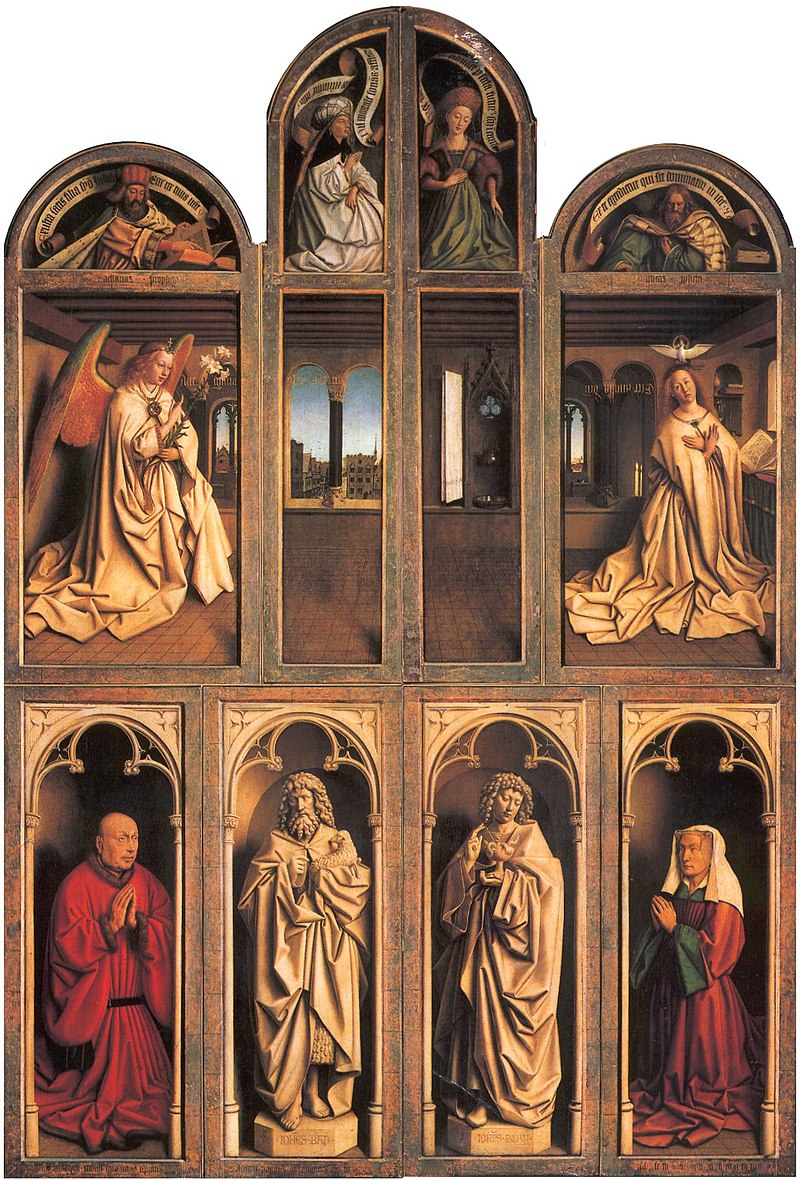
On the bottom section are the two donors and commissioners of the artwork along with St. John the Baptist (middle left) and St. John the Evangelist (middle right). Both saints are created in grisaille, which means that they mimic the look of a sculpture.
The upper half of the outer panels focus on the Annunciation. On the top are sibyls and prophets, most likely ones who wrote about the coming of Christ. In the middle left panel, we see the Archangel Gabriel in the middle of asking Mary if she will accepts God’s will to have Christ. Mary is on the right, and she has a dove is above her. This is a representation of the Holy Spirit descending onto her.
When the altarpiece is opened, the internal panels seem to focus more on the scene of the Adoration of the Lamb.

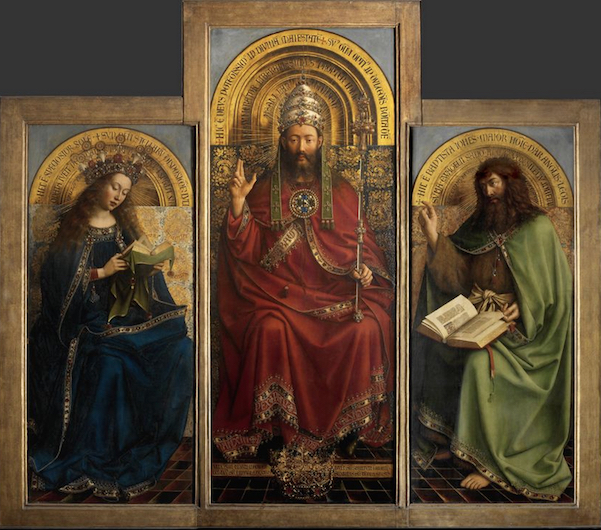
From the left to right, we see Adam, a choir, the Virgin Mary, Christ and/or God, John the Baptist, another choir, and Eve. Adam and Eve were most likely placed in this altarpiece as a reminder to viewers that because of them we were damned; however, as the Adoration demonstrates, because of Christ, we are no only damned.
Mary, here, is dressed in a beautiful embroidered blue dress. She is wearing an extravagant crown with halo rays coming from her head. Mary is also in the middle of reading. Next to Mary is the figure of, most likely, both Christ and God. Here, Christ and/or God is dressed in a vibrant red embroidered cloak. He is also wearing a papal crown that’s highly decorated, and he’s holding onto a cross staff. Similar to Mary, he has rays coming from the hat that demonstrates his holiness. Near his feet, we see a crown. Next to Christ is St. John the Baptist. He is wearing the typical hair covered attire seen in many paintings that include him, and he is also wearing a green cloak on top of it. St. John also has rays coming from his head.
In the bottom half, the left to right includes judges, knights, the Adoration of the Mystic Lamb, pilgrims, and hermits. In the bottom middle panel, there are a variety of individuals in the painting. In the middle of it is an altar with a sacrificial lamb on it. The lamb has a halo on him, and he is bleeding into a chalice. This is a clear reference to transubstantiation, when Christ turned the bread and wine into his body and blood at the Last Supper. On the top is a dove, which is a reference to the Holy Spirit that comes when transubstantiation occurs, and it shows how when the Holy Spirit does come, he can affect everything and everyone.
Lastly, the altar is surrounded by angels: two with trumpets, one with Christ’s cross and crowns, one with a column (from Christ’s flagellation), one with a stick with a sponge, and one with the lance Christ was poked with and the three nails. These angels are both adoring Christ’s sacrifice, and they are telling the viewers that this is the Adoration of Christ.

Overall, this is a beautiful painting. It was made with oil paint, and it’s extensively detailed. This shows the dedication that van Eyck felt to complete such an important altarpiece.
Feature image is also from Khan Academy