Georges Seurat’s A Sunday on La Grande Jatte is the piece that comes to mind when I think of Pointillism. Pointillism is a painting technique that utilizes color theory and optical illusion to produce a cohesive image far away from a collection of different colored dots and dashes. This type of art application, along with its typical subject matter of the mundane, the every day, or landscapes is considered to be Neo-Impressionism. Neo-Impressionism, unlike general Impressionism, focuses a lot on the scientific and systematic side of creating art. Both movements were still interested in nature as a subject matter and the spontaneous, fleeting moments of average living.
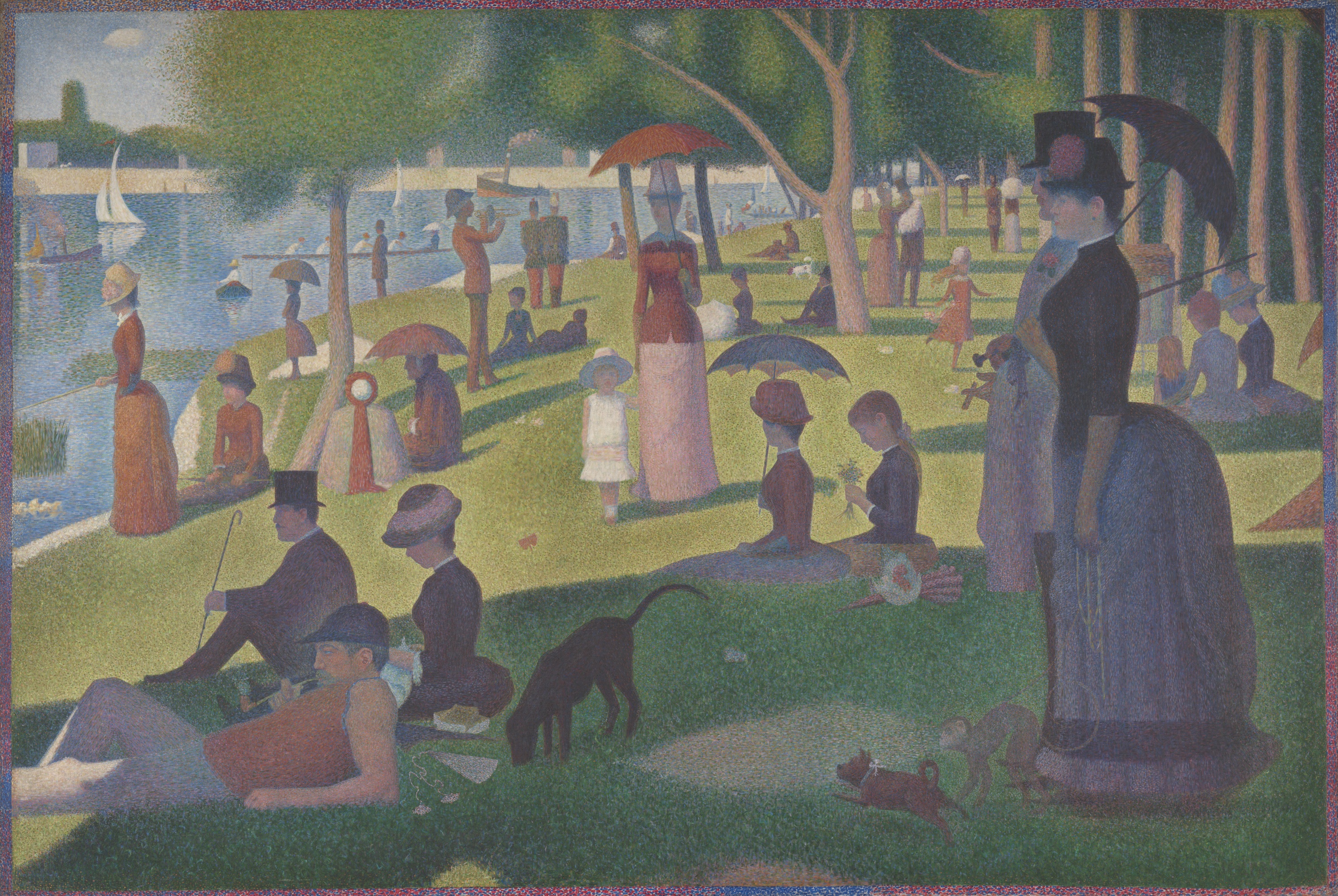
Explore Seurat’s Work in closer detail on Google Arts & Culture!
If you view a piece of Pointalism as closely as possible you will find that while from far away a section of the artwork appears green, the dots that compose it feature blues, oranges, yellows, and pinks. It is impressive how harmonious the end result of a piece can be despite the up close, minute details. This is all because of color theory. A chemist named Michel Chevreul proposed in his book (The Principles of Harmony and Contrast of Colours, and Their Applications to the Art) that by placing certain colors directly next to each other, a third color could be achieved if viewed from far away. These scientifically backed principles then became familiar to artists like Seurat, who applied their interest in color contrast onto canvas. The thoughtful juxtaposition of different colored dots eliminates the mixing portion of creating a painting, instead, the mixed pigment is an optical illusion for the viewer to experience.
Further Reading: