Hello and welcome back! I was thinking about what to write for this post, and while looking through photos of my trip to the Metropolitan Museum of Art, I came across a picture of a statue that I really enjoyed during my visit. The Statue of the Goddess Sakhmet was commissioned by King Amenhotep III for a mortuary temple in Thebes. Sakhmet in Ancient Egypt was a very powerful, fierce, and destructive Goddess. Her name translates to “She Who is Powerful” or “The Powerful One.” She is often associated with war, healing, and the power of the sun. She is depicted as a woman with a lion head because of her fierce nature, and the sun disk on her head shows her as the daughter of the Sun God Re. It is believed she was the destroyer of the enemies of the Sun God. Alternatively she is also known for her healing and medicinal aspects. It is because of this that she was popularly worshipped by many for all different reasons.
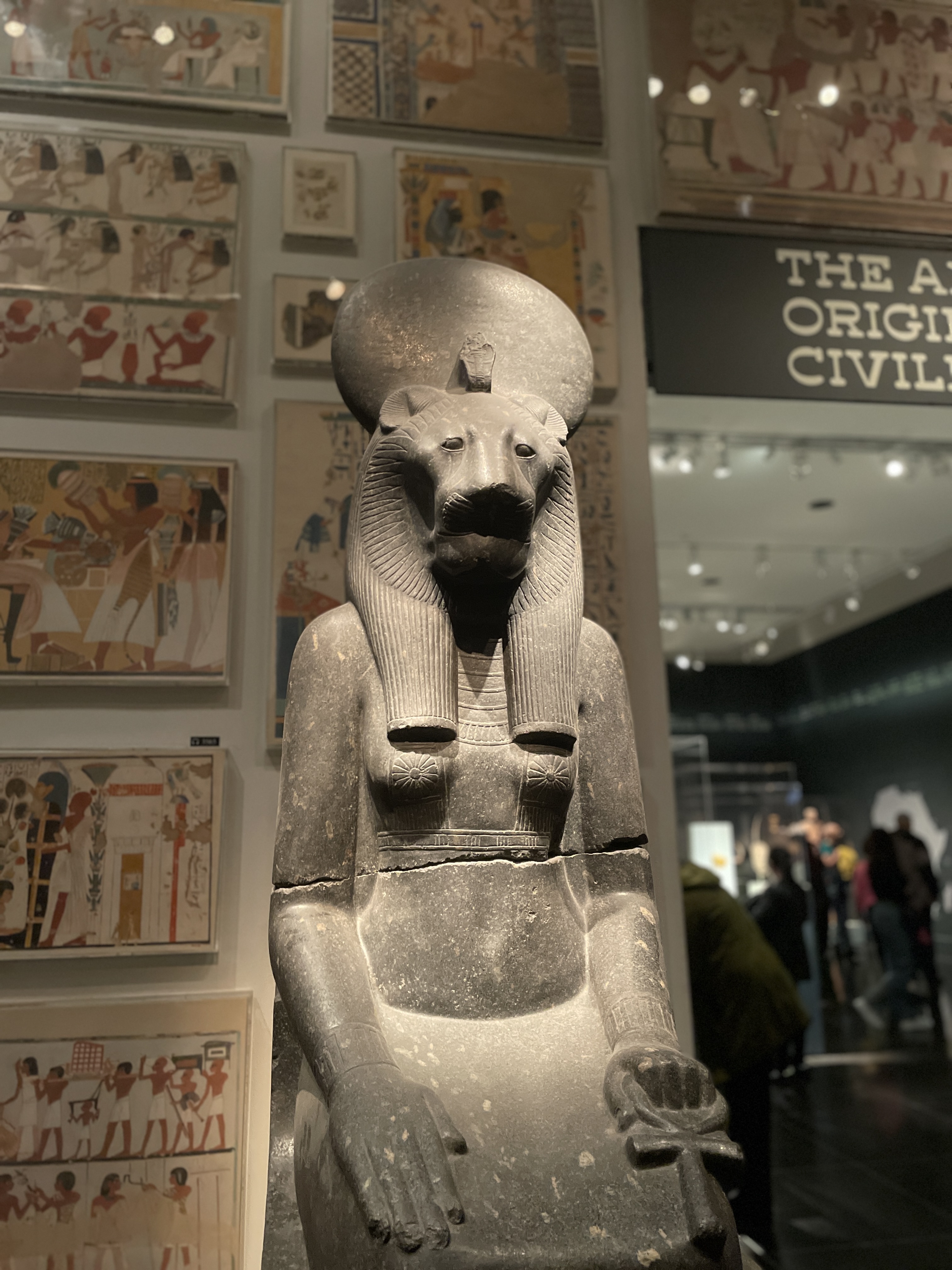
The statue itself is striking. Her small piercing eyes further send the message of her fierce nature. There are a lot of things that are significant to the time period such as the statues upright posture, the blunt angles, lack of musculature, minimal realistic anatomical details, the canon of proportions, and the stone not being pierced through at the arms. Although the details of musculature are minuscule, the detail in the lioness head pulls the attention of the viewer. The carved lines that make up the mane of the lion are meticulous and lead the viewer’s eye to the hair and decoration of the neck and breast.
The Statue of the Goddess Sakhmet is a very beautiful and fascinating work of art that has a deep history. I hope you all enjoyed learning about the statue and the history of the Goddess Sakhmet, and maybe this will inspire you to go see her in person one day as well!
~Marissa 🙂
Statue of the Goddess Sakhmet | New Kingdom | The Metropolitan Museum of Art. (n.d.). The Metropolitan Museum of Art. http://www.metmuseum.org/art/collection/search/544484