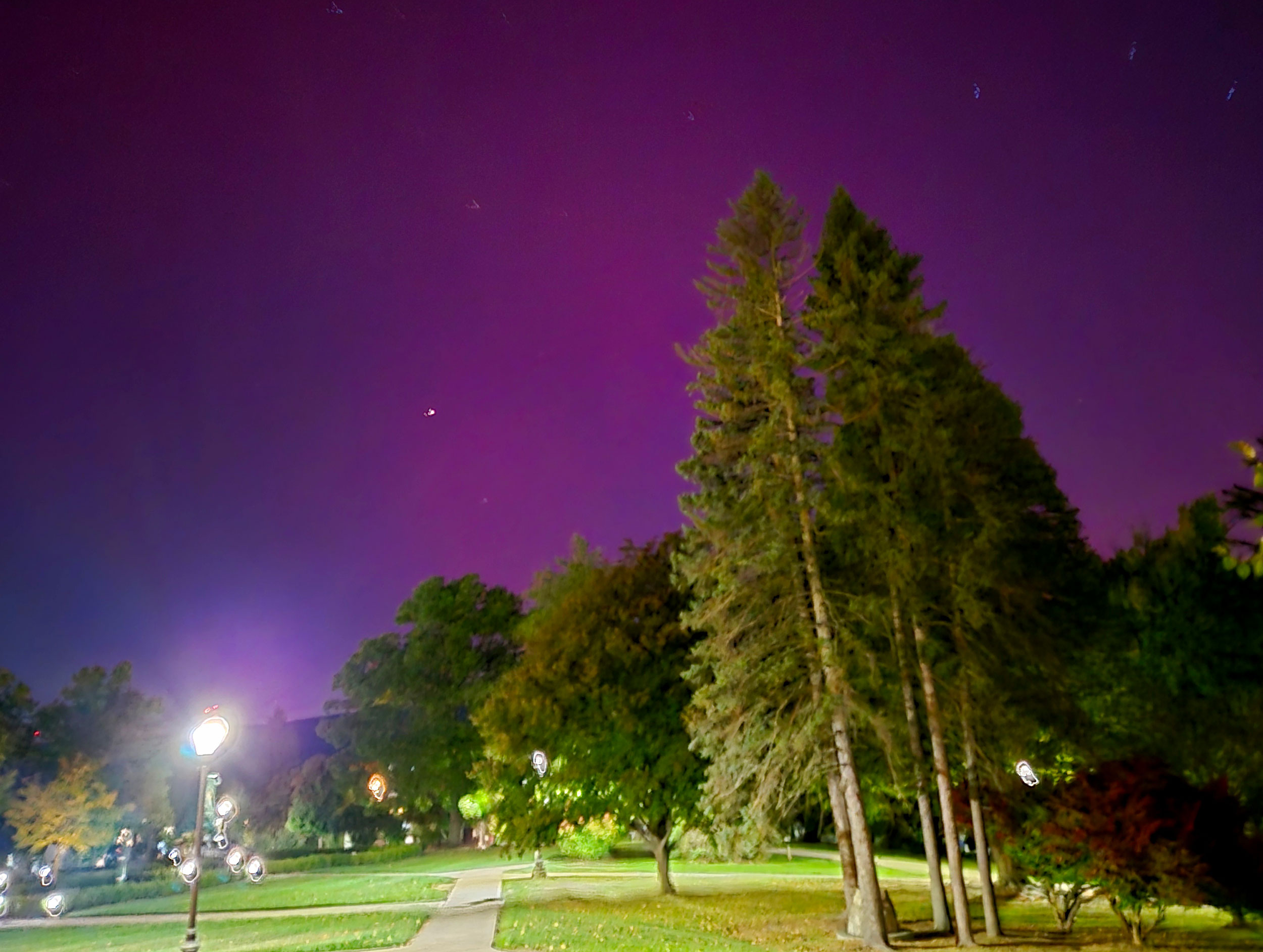
When do you think most profoundly?
Some people say shower thoughts are the best, and they honestly do work wonders. However, I seem to do my most world-shattering thinking at midnight (and beyond.) Whether its a late-night snack turned confessional with my roommate, or all-nighter vibes while finishing assignments, I seem to think best when the world is asleep. I like to think this is an effect of college life, but it’s always been true. Even when I was a small elementary school aged kid, my parents would often march up the stairs, hours after bedtime, to tell my sister and I to stop yapping in our shared bedroom.
Lucky for me, my siblings are exactly the same — if not worse — when it comes to thinking at night. While I don’t usually want to stay up until the wee hours of the morning, my siblings have made it a part of their life, and by extension, mine. Sibling court, drama, gossip, and debate always seems to happen at 3 AM in the morning, sprawled across the furniture and floor of my bedroom.
This past week had been no different. As midnight hit, my brother, Benjamin, and I had begun talking about one of the few shared academic interests between us: philosophy. For anyone who knows me personally, they would know that in addition to my art, I am pursuing a minor in Philosophy. My brother, a recent graduate of New Jersey Institute of Technology, just received his minor in Philosophy and Ethics this May, in addition to his Bachelors of Science in Information Technology. We talked about what we like to learn about, our different professors for philosophy (Can I get a round of applause for Marywood’s philosophy professors?) and papers we had written for some of our classes.
Ben had recently written a paper questioning what defines music. In his paper, he had discussed how humans seem to define different animals’ sounds as ‘music’ or ‘not music’. For example, whale song and bird song are considered to be somewhat musical, but a crow’s screech is not. Interestingly, for both whales and crows, the sounds they make are used for the same purpose: communication. My brother argued that what we call music is inherently based on aesthetics, or what sounds pleasing. He concluded his paper arguing that either all sounds made by animals (including humans) are music, or none of it is, and we, as humans, just arbitrarily decide what is considered “music” based on aesthetics and opinion.
Jumping off his paper, we began to wonder: what really is art, and how do we account for differences in opinion on the status of something as art?
What is Art?
The Philosophy of Art
The philosophy of art and aesthetics is an actual discipline in academic study of Philosophy, and it is covered in at least a few sections of Marywood’s required class, PHIL-120, The Examined Life.
There are a lot of definitions out there for art. During The Examined Life, I was introduced to a variety of definitions. Some people use the Formalist definition, whereas art is a composition of formal techniques and is something that is aesthetic. Formalists care more for the form of an art piece then the content. The Expressionist definition argues that art’s main goal is to express an idea or emotion with its audience. Other philosophers argue that we should follow the Representative definition of art, whereas art is meant to mimic reality and our perception of the world. Finally, others believe that art is defined by the Institution. Under this lens, art is art if a governing authority, like a museum, says so. These are only a few definitions of art that I have been exposed to.
Aside from definitions, it is also important to look at how art is perceived. Is art objective; is art considered art, no matter a person’s individual feelings? Or is art subjective; can someone call a work art, while another does not? What makes art aesthetic? I for one find Beardsley’s definition of aesthetic value being found in intensity intriguing, but philosophers like Aristotle, Wundt, Margoli, and Heuser all have their differing opinions, all of which have their own merits.
The philosophy of art is a vast and varied subject — a subject I know too little about. I have much to learn, but these philosophers provided a nice starting point for my brother and I. Together, my brother and I examined what actually is art.
How do we define art?
Reflecting on these definitions I briefly outlined above, I have never really been satisfied. I think that each of these definitions has their merits, but only go so far. To say that art is any one of these feels too restrictive. Under the Formalist lens, Marcel Duchamp’s Fountain (and many similar ready-made works) might not be considered art, but under the Expressionist and Institutional definitions of art, it is. Similarly, my still-lifes for class here might not be considered art under an expressionist lens, but would be considered so as Representative Art and Formalist Art.
Likewise, to define art as a combination of all of these definitions does not seem to fit either. Surely, there is work that does not hit all these criteria but would still be considered art by those who look upon it.
Talking with my brother, I began to ask myself: what does the artist aim to do?
For the sake of argument, my brother and I began to devise a definition for art that we could both agree on, a thought experiment from which to analyze art. Together, Benjamin and I decided that the best definition we could give for art would be any product, creation, or action of a living being that reflects its existence, experience, and context in relation to its world. This could be as complex as an intended piece, like any Van Gogh, or it could be as simple as a child’s scribbles. The child’s ‘scribbles’ might not be what we would put in a museum, but they are art because they reflect the wee artist’s experience as a child and their attempt to depict the childhood they are living and the ideas that they have. This definition generally covers everything we could think of — Duchamp’s Fountain, Prehistoric Cave Paintings, Van Gogh’s The Starry Night, Mondrian’s De Stijl, whale song, crow screeches, and even human speech and action. No matter what an individual thinks, the product, creation, or action is certifiably art.
How do we account for differences in opinion when it comes to art?
Settling on this definition for the sake of argument, my brother and I then turned to the question of why people see art differently? Art definitely does seem to be seen very differently among people. How is it that we can define art a certain way, and other people still see it differently? Why do some people think Duchamp’s Fountain is genius, but others think it is total bologna?
Benjamin and I raised the following solution: that there are two ways of categorizing “art.” We used the terms “Constructive Art” and “Interpretative Art.”
Constructive Art is what I have outlined already above. Constructive Art defines art as any product, creation, or action of a living being that reflects its existence, experience, and context in relation to its world. No matter the arguments over whether something is art or not, anything that qualifies for this status as constructive art is undeniably art.
When humans squabble over what is art, then that’s what we would call Interpretative Art. Interpretative Art, we defined, as any product, creation, or action that reflects any one individual’s existence, experience, and context in relation to its world Interpretive Art depends on what we perceive as individuals that art is based. This could be based on aesthetics, biases, and social context for each individual.
You might be reading this and going, “Rebecca, how are those definitions any different?” Honestly, I can see your point, so I will try to explain the best that I can. Constructive Art just asks that any being creates something that depicts their existence, experience, and context in relation to the world. It does not matter if I, the viewer, feel my experience has been reflected in the product; instead, it only matters if any living being’s experience has been reflected in the product. With Interpretative Art, is it is a little bit different. The product, creation, or action may reflect a living being’s experience, but it also has to reflect the viewer’s experience.
For example, we will return to Duchamp’s Fountain. Under Constructive Art, Duchamp’s piece is art, no matter who the viewer is, because the piece expresses Duchamp’s existence, experience, and context in this world. However, under Interpretative Art, it might not be so clear. For some people who agree with the idea that the name “Fountain” makes the urinal art, then this would be considered art for that person. For someone who does not buy this idea that the name makes the urinal art, then it would not be considered art.
What makes Constructive Art and Interpretative Art different than Objective and Subjective art?
At 3 AM in the morning, after hours of talking about this, we finally asked this question. At the time, we could not really put a finger on it. However, I think that the key difference here is that both Constructive Art and Interpretative Art are both objectively art. We’re not arguing that Interpretative Art is considered less of art than Constructive Art. These two definitions just aim to categorize how we view art. Constructive Art encompasses all that is art — it strips away biases from the equation. (There is something to be said that Constructive Art is, in a sense, objective. We make the claim here that no matter what discourse is made, that Constructive Art is art). However, Interpretative Art, is not subjective art. Yes, there are differences in opinion to whether someone considers something art or not. Duchamp’s Fountain may or may not be art, depending on the individual — which sounds like subjective art. The key difference, however, is that no matter the discourse, anything that can be classified as Interpretative Art, is undeniably art too. Because someone believes it to be art, is also objectively art. Person A might believe a work to be art, and Person B may not — but because Person A does think it is art, then it is objectively Interpretative Art. All Interpretative Art does is account for the differences in opinion among the people, while still upholding their opinion as objective.
Implications of Constructive and Interpretative Art
These definitions actually raise some interesting implications, some more complicated than others. This idea of Constructive Art is heartening for those of you, like me, who detest generative artificial intelligence. Under this view, images made from artificial intelligence are not art. Not only are they created by a non-living being, but AI is what my brother calls a “statistical model.” AI cannot depict its own reality, as it creates from a data set of a multitude of humans’ realities, and it depicts the experience and context of a world it is not an agent in. For artist like me who despise the rise of artificial intelligence, this is heartening news! Furthermore, the artificial intelligence itself is an art, as it depicts the reality of a world that is changing and the drive for innovation by its human creator. The artificial intelligence engine is the art of its creator, but the product made by AI is not.
Interestingly, another implication arises about action when considering Constructive Art. Actions like walking, running, jumping are not art. However, walking with swagger, like a runway model… would that be considered art? A case could be made that it would indeed be considered art. Noticeable in this definition is also the lack of intentionality for art. Under our definition, talking in itself is just as valid an art as singing, as both express our experiences in context with the world.
As for Interpretative Art, there are some incredibly alarming implications too. Under the Constructive definition, AI generated images are not art. However, under the Interpretative Definition, AI images would be considered art, as there is at least one person on the planet who does think that AI images are art forms. As an art major, I am deeply uncomfortable with that conclusion — which tells me that this theory of Constructive and Interpretative Art needs workshopping. Let me be clear: I vehemently believe that AI generated images are never art, so this does trouble me. I will never allow a definition of art where AI images are included. Albeit a flawed set of definitions, in my opinion, this example of AI shows that an Interpretative work of art does not necessarily have to be Constructive to be considered art under this thought experiment.
Conclusion
I have written a lot about these ideas of what art is, Constructive Art, and Interpretative Art, but at the end of the day, I hesitate to accept these definitions. It would be pompous and naive to think that I could really define what art is, or to dictate what is art. I do not intend to define art once and for all; I merely attempt to offer a new way of looking at art. These ideas are less so my fully formed beliefs and more so a thought experiment my brother and I devised for fun. I think there is a lot to consider within this model, but I also think there is so much to art that is being left out, and a lot that makes me uncomfortable with these definitions of art to the point that I feel that the definition could be discarded. The fact that AI is considered art under this perceived Interpretative lens is a viewpoint I just cannot accept, and makes the theories null and void for me.
Benjamin and I had discussed these ideas for close to three hours, with increasing excitement — just for us to end up at this roadblock. What was the point of debating these definitions if they turned out to be inaccurate, or at least unsatisfying, to my brain? Was all of this for nothing?
I’d say we actually learned more about art then if we had agreed upon a set of definitions or theory that worked perfectly. This model allowed us to explore what we believed to be true about art, and what is not. These definitions gave us the opportunity to truly consider if art has a sense of subjectiveness or objectiveness to it. I had always considered all art to be subjective, but given this definition of Interpretative Art, I am not sure. How can I reconcile a world where all art is subjective, but that makes it possible for AI images to be considered art? This represents a clash in my values and world-beliefs, and I have to figure out a way to think my way around the problem and reconsider my beliefs about the world. Perhaps there are degrees to subjectiveness and objectiveness in art, which are upheld by this thought experiment carried out by my brother and I. Overall, I might not agree with the definitions and implications we had discovered, but it is indisputable that these definitions forced me to consider art more analytically and critically then I have before, even if I am still left without answers.
But isn’t that the beauty, the artistry, of philosophy?
For me, philosophy has never been about finding the answers and solving all the problems. No, philosophy has always been about asking questions and exploring the world. It is about wonder and curiosity.
I don’t think I will ever fully know what truly is art. Heck, even now, I’m not happy with the definitions I gave here today. I don’t think that Constructive and Interpretative Art are the answers here. Maybe art can’t be defined. Even though I don’t fully believe this model my brother and I have proposed, I think exploring it is worthwhile. I am willing to admit that I am wrong — I know I am. Yet, I also know that thinking about the rules that regulate what we call art is a noble endeavor, and it expands our ideas of what art could be. We unlock creativity and imagination when we explore and push the boundaries of our craft and our world.
I would love to hear what you all think about these ideas my brother and I propose! What do you think of these definitions? Is there a kernel of truth in what we are considering? Do you think there is a difference in Constructive Art, Interpretative Art, Objective Art, and Subjective Art? Or do you think that these are just the ramblings of two sleep-deprived college students?
Furthermore, what do you think defines art? Why do people see art differently? Tell me your ideas on the philosophy of art! I’d love to hear them!
Happy philosophizing!
-Rebecca Prowse